

Doctoral schools
The Microb’UP Institute is associated with three multidisciplinary doctoral schools of the Université Paris Cité: ED MIcrobeS, ED 562 “Bio Sorbonne Paris Cité” (BioSPC) and ED 563 “Medication, Toxicology, Chemistry, Imaging” (MTCI), which cover a wide range of topics and bring together all the teams of the Microb’UP Institute.
Microb’UP is associated to MIcrobeS, BioSPC and MTCI doctoral schools
MIcrobeS (https://ed-microbes.u-pariscite.fr/): this doctoral scool covers broad areas of research in the fundamental biology of microorganisms, host-pathogen interactions, microbial ecosystems, public health and clinical science, employing a range of approaches from bacteriology, virology, parasitology, mycology, molecular, cellular and structural microbiology, genetics, genomics, infectious diseases, epidemiology and modelling. The development and evaluation of diagnostic and preventive strategies – notably vaccines – as well as innovative therapeutic approaches for infectious diseases also fall within the scope of the doctoral programme.
eMail: ed.microbes@u-pariscite.fr
BioSPC, ED562 (https://ed562.u-paris.fr/): this doctoral school offers to PhD students a very wide range of fields covering most of the disciplines of Biology and an offer of laboratories for the preparation of their thesis that has few equals in France and Europe. BioSPC is divided into four departments with a strong autonomy:
– Department of Genetics (GENYX)
– Department of Immunology (IMMUNO)
– Department of Fundamental Mechanisms od Living Organisms (MECA)
– Department of Physiology and Pathology (PP)
eMail: ed562.bio@u-paris.fr
MTCI, ED563 (https://ecolesdoctorales.parisdescartes.fr/ed436/): this doctoral school covers a broad multi-disciplinary field, ranging from fundamental questions to clinical applications, with biomedical and therapeutic research as a common thread. The objective of the PhD school is to offer PhD students a rich and stimulating multidisciplinary environment, allowing them to enrich their initial skills to better understand problems at the chemistry/biology/health interface. To achieve this, it relies on a group of internationally recognized research teams, capable of offering training through research of the highest level.
eMail: ed563.mtci@u-paris.fr
News
The MIcrobeS Doctoral School: a strategic framework for doctoral training in microbiology and infectious diseases at Université Paris Cité
The Microorganisms and Infection Doctoral School (MIcrobeS) is officially opening at Université Paris Cité for the 2026 academic year. The MIcrobeS Doctoral School is led by Isabelle Martin-Verstraete, Professor of Microbiology at the Faculty of Science, and Yazdan...
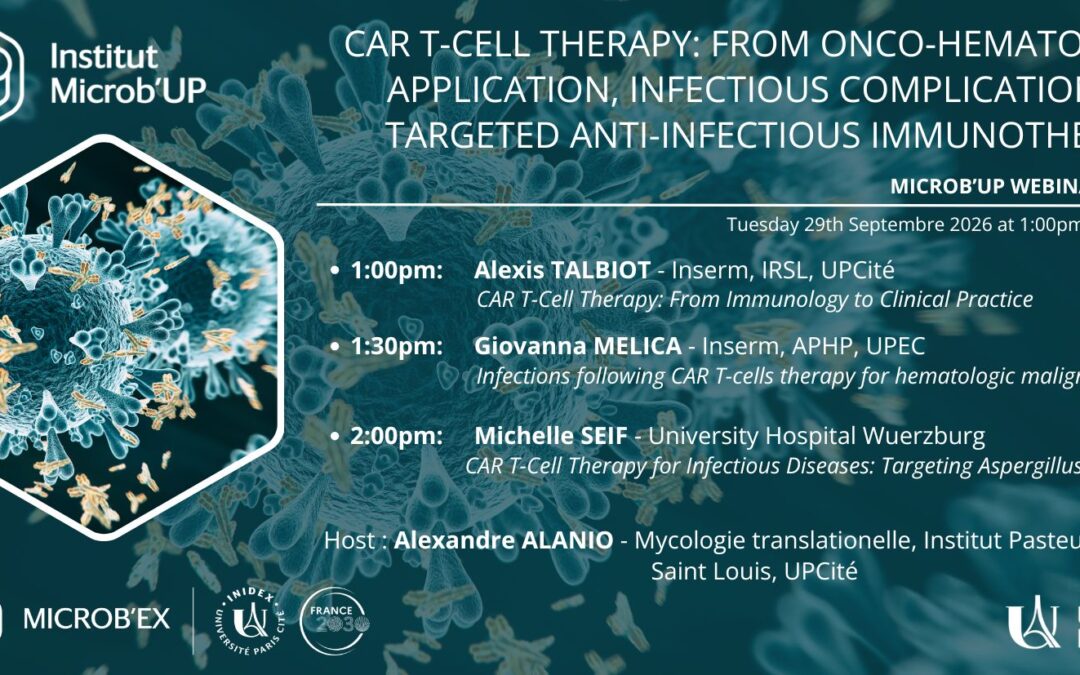
MICROB’UP Webinar Series: Car T-Cell Therapy: From Onco-Hematology Application, Infectious Complications to Targeted Anti-infectious Immunotherapy – September 29th 2026
MICROB'UP Webinar Series: Car T-Cell Therapy: From Onco-Hematology Application, Infectious Complications to Targeted Anti-infectious Immunotherapy - September 29th 2026 Tuesday, September 29th 2026, at 1:00pm (Paris) 1:00pm: Alexis TALBIOT - Inserm, IRSL,...
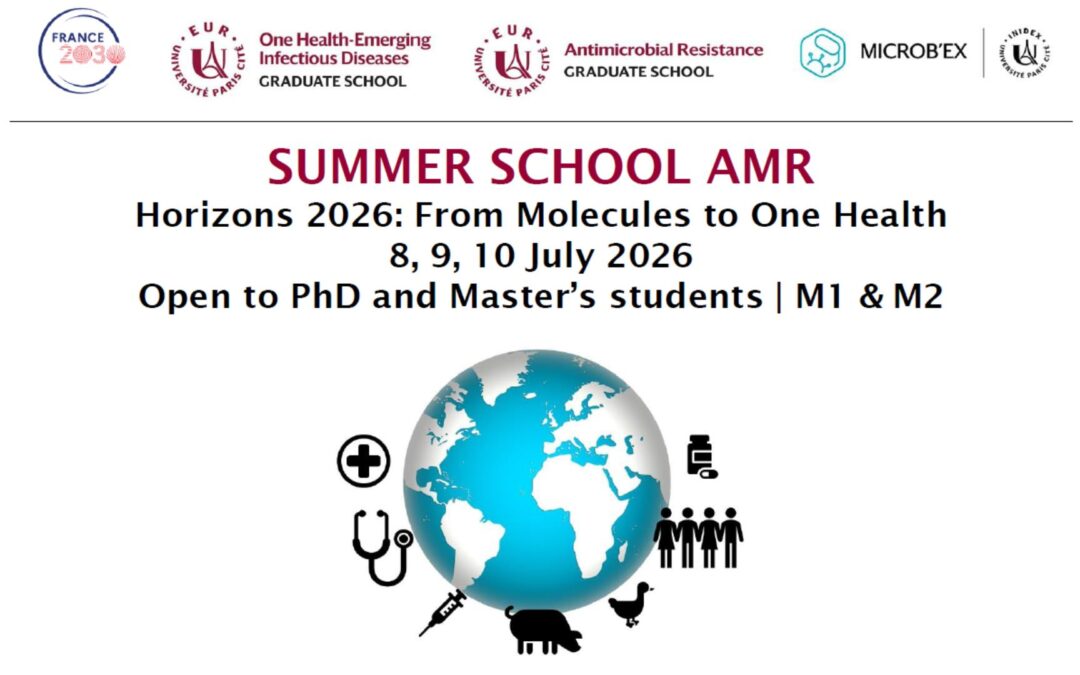
Summer School Antimicrobial Resistance : 8-10 July 2026
Graduate Schools Antimicrobial Resistance and One Health & Emerging Infectious Diseases as well as the InIdEx MICROB'EX are organizing the Summer School "Horizons 2026: From Molecules to One Health", dedicated to antimicrobial resistance, from 8 to 10 July...

MICROB’UP Webinar Series: Antimicrobial Resistance: Lessons From Around the World- June 16th 2026
MICROB'UP Webinar Series: Antimicrobial Resistance: Lessons From Around the World - June 16th 2026 This webinar has been recorded, find the recording HERETuesday, June 16th 2026, at 12:00pm (Paris) 12:00pm: Senjuti SAHA - Child Health Research Foundation: The...