

Microbes
When you hear the word “microbe”, what comes to mind? A disease? A virus? Something that should be eliminated at all costs? Yet microbes are not all our enemies, far from it. Invisible to the naked eye, they have inhabited our planet for billions of years and play an essential role in ecosystems and in our own bodies. Bacteria, viruses, yeasts and microscopic fungi: discover what lies behind these often-confused terms through the most frequently asked questions about microbes.
What is a microbe?
Microbes is the term commonly used to refer to microorganisms, i.e. microscopic organisms invisible to the naked eye. Their size varies greatly, ranging from a few nanometres (viruses) to several tens of micrometres (bacteria, fungi, protozoa). The largest among them are barely visible! To give you a sense of scale: the thickness of a human hair is on average 70µm.
But in 2022, a discovery defied scientific definitions: the bacterium Thiomargarita magnifica, discovered in Guadeloupe on mangrove leaves, measures no less than 1 cm in length! An exception, clearly visible to the naked eye!
Where are microbes found?
Microbes are found almost everywhere on our planet: in the air, water and soil, but also in clouds, glaciers and deserts, they are even capable of surviving at temperatures of over 100°C in geyser springs or near volcanoes! And, of course, on and inside the human body.
In short, there is virtually no environment on Earth without microbes, except for the most extreme ones where even the chemical reactions necessary for life cannot take place.
How long have they been around?
They have been around for over 3.8 billion years, long before the appearance of plants, animals and humans, and are by far the oldest and most abundant form of life on Earth.
How many are there?
It is estimated that there are around 1030microbes on our planet (a billion billion billion).
They account for the largest terrestrial biomass after plants.
Did you know that the human body alone is home to nearly 40 quadrillion bacteria? That’s a number comparable to the number of our own cells!
Scientists classify microorganisms into different categories:
Bacteria
Bacteria are single-celled organisms (consisting of a single cell) without a nucleus. Their genetic material is found in the cytoplasm. They are generally between 0.5 and 5 micrometres in size. They come in a wide variety of shapes (spherical, elongated, spiral, etc.) and lifestyles. Some are capable of forming highly organised structures called biofilms: such as dental plaque, for example.
They are well known for their pathogenic potential:
You have probably already heard of Staphylococcus aureus, which causes skin infections, Pneumococcus, which causes pneumonia, or Salmonella and Escherichia coli, which are often implicated in outbreaks of food poisoning.
But did you know that some of them are essential to our daily lives?
This is the case with Streptococcus thermophilus and Lactobacillus bulgaricus, which play an essential role in the process of turning milk into yoghurt, or Oenococcus oeni, which is involved in wine fermentation, and even Lactobacillus acidophilus, which plays a key role in protecting the vagina against infections… And there are countless examples like these in our daily lives!
In reality, the majority of bacteria are not pathogenic. Many of them have no effect, and a large number are beneficial to our health, the environment or even agriculture.
Archaea
Archaea are also single-celled organisms, lacking a nucleus and comparable in size to bacteria (1 to 5 µm).
When they were first discovered, they were initially thought to be a particular type of bacterium – perhaps ‘primitive’ bacteria? Hence the term ‘Archaebacteria’. However, genetic analyses have shown that they belong to a distinct biological group in evolutionary terms and share characteristics common to both bacteria and eukaryotic organisms (of which we are a part).
To date, no archaeal species has been identified as a pathogen.
Archaea are particularly famous for their ability to live in extreme environments, long considered incompatible with life: geysers, hyper-acidic or hyper-saline environments, glaciers…
However, they are also found in much more familiar environments, including the human microbiome, particularly in the gut, where their role is still the subject of extensive research.
Archaea play an important role in major biological cycles, such as the carbon and nitrogen cycles, and thus contribute to the balance of terrestrial and aquatic ecosystems.
Viruses
Viruses are the smallest known microorganisms, ranging in size from 20 to 300 nanometres (up to 100 times smaller than a bacterium). They are also the most numerous organisms on Earth: their number is estimated at around 10³¹ viral particles.
They consist of a protein shell called a capsid, inside which their genetic material is enclosed. Some also have an additional envelope derived from the cell they infect.
Unlike other microbes, viruses are not capable of multiplying on their own. They are obligate parasites: to reproduce, they must infect a host cell and hijack its cellular machinery.
This host cell can be human, animal, plant, or even a bacterium!
In the latter case, they are known as bacteriophages. These viruses play a major role in regulating bacterial populations, particularly in the oceans, where they have a significant influence on ecological balances.
While some viruses are responsible for well-known diseases (flu, COVID-19, rabies, HIV, measles, etc.), others are currently being studied or used as therapeutic tools, for example in phage therapy or gene therapy.
Microscopic fungi
Fungi are eukaryotic organisms, meaning they have a nucleus that contains and protects their genetic material. They may be microscopic for all or part of their life cycle.
They can be:
Single-celled, as is the case with yeasts.
Multicellular, forming filaments called hyphae that organise themselves into mycelium. When the mycelium becomes dense enough, it can become visible to the naked eye, such as mould on food or the mushrooms we eat.
Some of them are pathogenic. Among yeasts, you may be familiar with Candida albicans, the main cause of vaginal yeast infections. They can also cause skin conditions such as ringworm, or be involved in certain respiratory infections, such as Stachybortys chartarum, the notorious black mould that can be found in our homes when they are too damp…
However, just like bacteria, many of them are not pathogenic and are extremely useful. They are often found in the food industry for cheese production (e.g. Penicillium camemberti, Penicillium roqueforti…) or for fermentation (beer and bread using brewer’s or baker’s yeast: Saccharomyces cerevisiae). But they are also very useful in healthcare. Did you know that the first known antibiotic, penicillin, is produced by a mould? (Penicillium chrysogenum). They also play a very important role in the environment, where they help break down organic matter.
Protozoa
Protozoa are single-celled eukaryotic microorganisms, meaning they have a nucleus that contains and protects their genetic material. They are generally larger than bacteria, ranging in size from 10 to 100 micrometres.
They live mainly in moist environments: fresh water, damp soil, aquatic environments, but also inside other living organisms.
Some protozoa are pathogenic to humans and cause serious diseases. Well-known examples include: Toxoplasma gondii, which causes toxoplasmosis, and Plasmodium falciparum, which causes malaria.
However, not all protozoa are dangerous. The vast majority are non-pathogenic, and some even play a beneficial or essential role in ecosystems.
In natural environments, many protozoa feed on bacteria and thus help regulate microbial populations. They play a key role in aquatic food chains, serving as food for other microscopic organisms or small invertebrates.
In humans, the presence of non-pathogenic protozoa has been documented in the gut. Their exact role is still under investigation, but some research suggests that they may contribute to the balance of the gut microbiota and the regulation of the immune system.
Thus, as with other microbes, protozoa should not be viewed solely as pathogens, but as key players in the functioning of ecosystems, with only a minority causing disease.
As you will have realised from these examples, microbes are not merely the cause of disease. To be more precise, it is estimated that less than 0.1% of all known species are pathogenic bacteria.
They are present everywhere around us, mostly harmless, and often essential even to our health and survival. A reality far removed from the exclusively negative image often associated with them.
À lire aussi
The MIcrobeS Doctoral School: a strategic framework for doctoral training in microbiology and infectious diseases at Université Paris Cité
The Microorganisms and Infection Doctoral School (MIcrobeS) is officially opening at Université Paris Cité for the 2026 academic year. The MIcrobeS Doctoral School is led by Isabelle Martin-Verstraete, Professor of Microbiology at the Faculty of Science, and Yazdan...
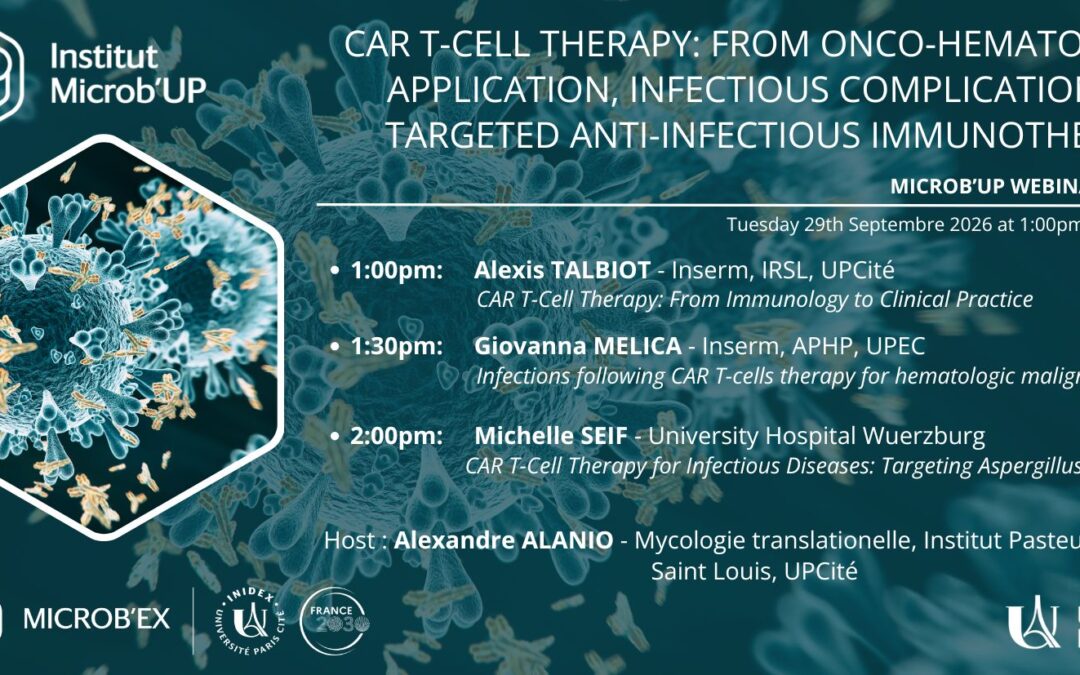
MICROB’UP Webinar Series: Car T-Cell Therapy: From Onco-Hematology Application, Infectious Complications to Targeted Anti-infectious Immunotherapy – September 29th 2026
MICROB'UP Webinar Series: Car T-Cell Therapy: From Onco-Hematology Application, Infectious Complications to Targeted Anti-infectious Immunotherapy - September 29th 2026 This webinar has been recorded, find the recording HERE Tuesday, September 29th 2026, at...
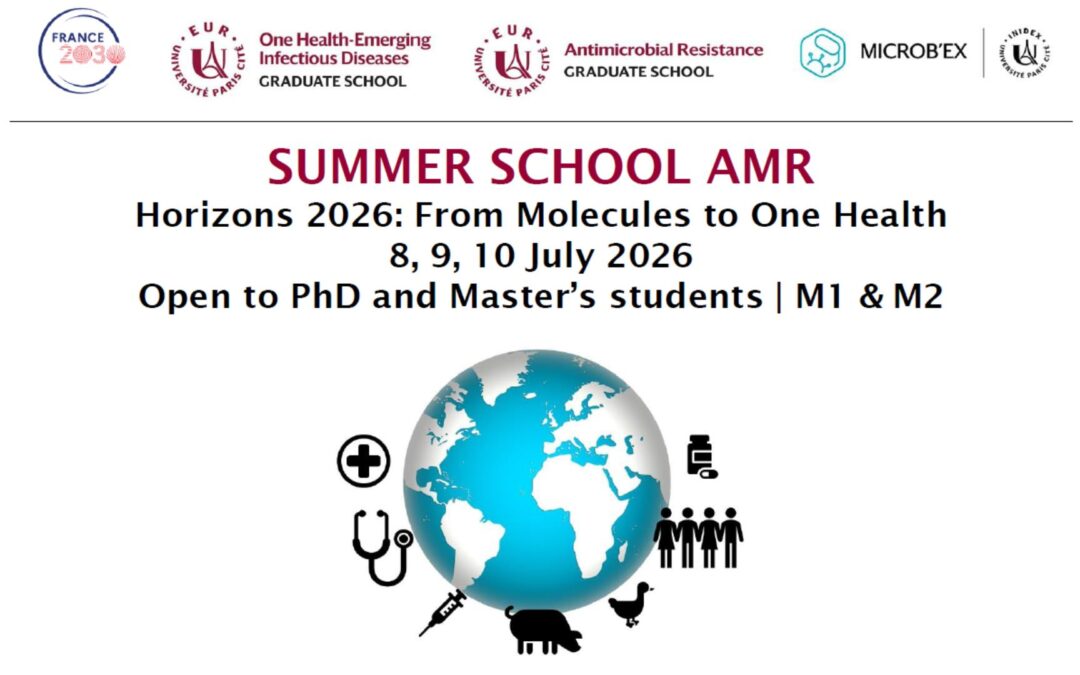
Summer School Antimicrobial Resistance : 8-10 July 2026
Graduate Schools Antimicrobial Resistance and One Health & Emerging Infectious Diseases as well as the InIdEx MICROB'EX are organizing the Summer School "Horizons 2026: From Molecules to One Health", dedicated to antimicrobial resistance, from 8 to 10 July...

MICROB’UP Webinar Series: Antimicrobial Resistance: Lessons From Around the World- June 16th 2026
MICROB'UP Webinar Series: Antimicrobial Resistance: Lessons From Around the World - June 16th 2026 This webinar has been recorded, find the recording HERETuesday, June 16th 2026, at 12:00pm (Paris) 12:00pm: Senjuti SAHA - Child Health Research Foundation: The...